
synopsis
Few novels have changed the look and language of science fiction as decisively as Neuromancer. Published in 1984, William Gibson’s debut sent readers into a world of data thieves, surgically altered bodies, immense corporations, and intelligences moving unseen through the matrix. With Count Zero (1986) and Mona Lisa Overdrive (1988), he expanded that vision into the Sprawl trilogy: three novels that helped define cyberpunk and gave the approaching digital age a vocabulary and a visual identity.
What made these books startling was not simply their technology, but the people using it. Gibson’s future belongs to hustlers, mercenaries, artists, and outsiders trying to survive in systems they cannot control. His cities are crowded with discarded machinery and expensive new distractions; his characters know the price of a bodily repair, a stolen secret, or an hour of escape. The future has already been lived in, and its inhabitants are getting on with their lives.
Neuromancer begins with Case, a gifted console cowboy whose damaged nervous system has cut him off from cyberspace. An offer to restore his abilities draws him into a job whose real purpose is concealed from nearly everyone involved. Alongside Molly, the lethal, mirror-eyed bodyguard, he moves from the streets of Chiba City toward an encounter with artificial intelligence unlike anything his employers have prepared him for. Winner of the Hugo, Nebula, and Philip K. Dick awards, the novel combines the momentum of a crime story with unsettling questions about memory, identity, and the boundaries of human consciousness.
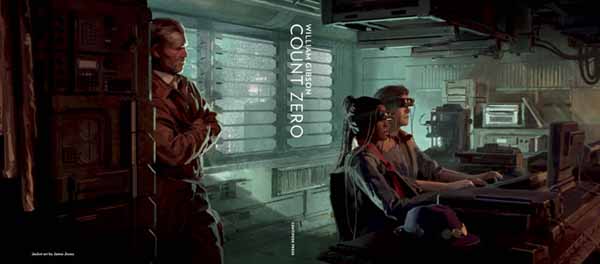
Count Zero widens the frame. Seven years later, a mercenary named Turner, an inexperienced hacker calling himself Count Zero, and an art specialist named Marly Krushkhova follow separate trails through the changed world. Corporate intrigue intersects with mysterious artworks and presences in cyberspace that appear to take the forms of gods. The novel’s interwoven stories give the Sprawl new depth: behind the violence and the deals are questions about who creates, who owns, and what remains of a person when experience can be bought, copied, or reconstructed.
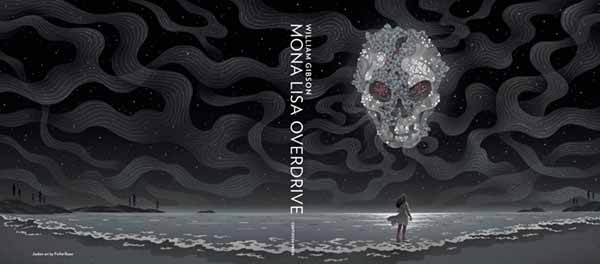
Mona Lisa Overdrive brings those accumulating possibilities to a culmination. A young woman whose resemblance to a celebrity makes her dangerously valuable, a Japanese girl sent to London, an artist building machines in an industrial wasteland, and a star of simulated experience are drawn into an increasingly intricate web. Characters and consequences from the earlier novels return, but Gibson keeps the focus on individual lives caught in events of almost unimaginable scale. The trilogy’s concerns with fame, artificial intelligence, memory, and the separation of mind from body converge in its final movement.
The Sprawl trilogy is often discussed for what it anticipated. Its enduring pleasure is also in the writing: the exact detail, the unexpected image, the clipped exchange that makes an unfamiliar world suddenly convincing. These are novels to revisit not as a checklist of predictions, but as densely imagined stories that still offer strange places to enter and difficult questions to carry away. Read together, they reveal the range of a vision that began with a criminal’s longing to return to the matrix and grew into something far larger.
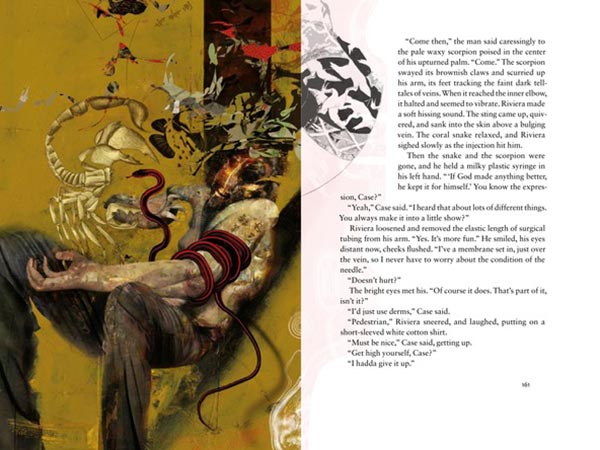
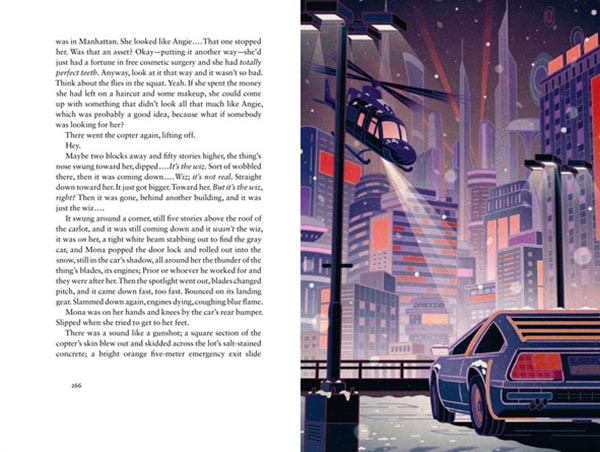
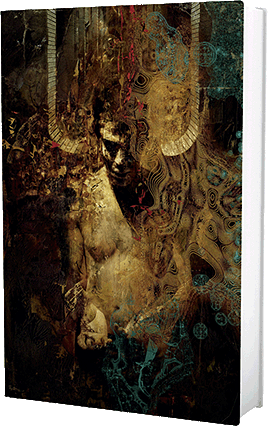
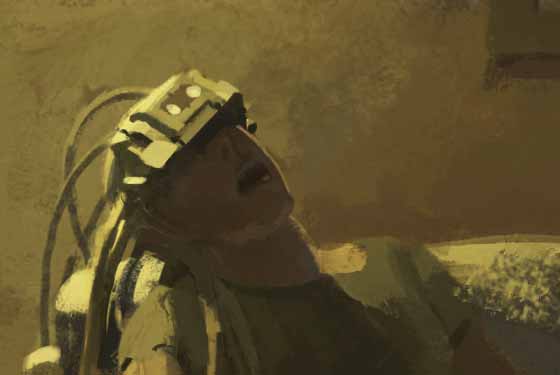
Each book has a new introduction and new artwork: Neuromancer: Eileen Gunn, introducer; Dave McKean, artist ** Count Zero: Bruce Sterling, introducer; Jaime Jones, artist ** Mona Lisa Overdrive: John Shirley, introducer; Feifei Ruan, artist. Neuromancer is signed by Eileen Gunn and Dave McKean. Count Zero is signed by Jaime Jones. Mona Lisa Overdrive is signed by John Shirley and Feifei Ruan. Each book measures 6⅜ × 9⅝ inches. Neuromancer is 376 pages while the sequels are 344 pages each. The books are illustrated in color throughout. The signed copies are limited t0 500 numbered and signed sets. Each book is wrapped in black Brillianta cloth with a printed panel on textured paper on the front board. They are stamped on the spines. Each dustjacket is wrapped in Mylar, and all three volumes are enclosed in a handsome slipcase. They are not signed by William Gibson.
edition information